
Prepared for the Honeywell Aerospace government relations team by Quorum

www.quorum.us

Prepared for Honeywell Aerospace

Every bill, chamber and state on your agenda, in one workspace.

Quorum gives your government relations team and your outside firm one shared view of the bills, committees and lawmakers on your issues, with AI agents that prepare the first pass. Take the ALERT Act: the House passed it 396 to 10 in April, while the Senate's ROTOR Act fell short in the House in February, and three states have their own ADS-B data bills.

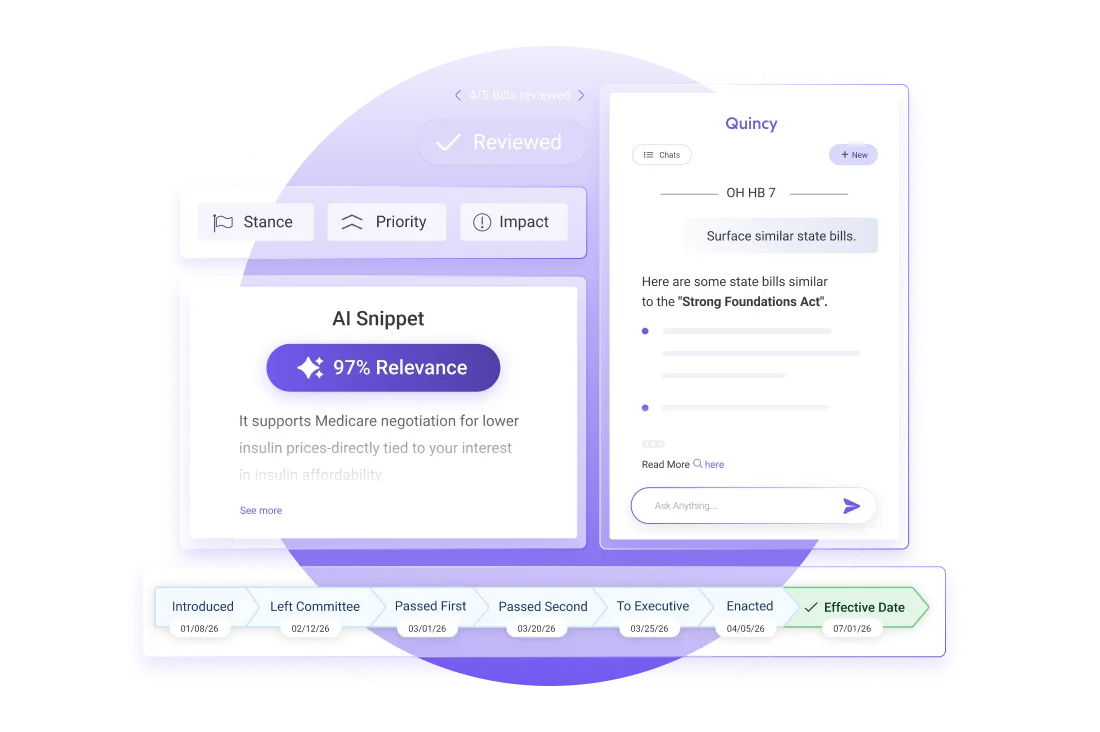
Quorum AI bill tracking illustration showing an AI relevance snippet, stance, priority and impact tags, a Quincy chat panel and a bill status timeline

Your agenda, in context

The collision-avoidance fight now runs through the Senate.

Recent federal and state records on the issue your team put on the record.

Federal: House

The House chose its own bill.

On April 14, 2026, the House passed H.R. 7613, the ALERT Act, 396 to 10. The Senate referred it to its Commerce, Science, and Transportation Committee the next day.


Track the House-passed text and the Senate committee as separate stages, each with its own owner.

Federal: Senate

The Senate's version stalled in the House.

The Senate passed S. 2503, the ROTOR Act, on December 17, 2025. On February 24, 2026, a House vote to pass it under suspension of the rules failed 264 to 133, short of the two-thirds required.


Watch both bills until the chambers settle on one text.

State

ADS-B data is a state issue too.

Michigan introduced HB 6332 on September 22, 2026, to bar landing fees for small aircraft based on ADS-B data. New York and Pennsylvania introduced similar bills in May and June 2026.


Follow state ADS-B data bills alongside the federal equipage debate.

Statuses as of November 6, 2026, from the Quorum records listed in Sources.

Where ADS-B data rules are moving

Congress is writing equipage rules. Three states are writing data rules.

The House-passed ALERT Act would have the FAA set collision-avoidance standards and require covered aircraft to carry collision prevention technology under a rule taking effect no later than December 31, 2031.

At the same time, three states have introduced bills limiting how airports can use ADS-B data to charge aircraft.

H.R. 7613 text and Quorum bill records, as of November 6, 2026

396-10
House vote passing the ALERT Act, April 14, 2026
264-133
House vote on the Senate's ROTOR Act, February 24, 2026, short of two-thirds
3
States with pending bills on ADS-B-based aircraft fees

As of November 6, 2026, three states have pending bills on ADS-B-based aircraft fees: Michigan (HB 6332), Pennsylvania (H.B. 2546) and New York (S.10490 and A.11568). No state law on the issue was found.

  • Law in place
  • Bill introduced
  • No bill found

Michigan

Bill introduced

HB 6332, introduced September 22, 2026: bars ADS-B-based landing fees for small aircraft.

As of Nov 6, 2026

Early movement, not yet a patchwork. In Quorum, new state bills on the issue land in the same tracking view as the federal bills.

Built from public bill records. Not a complete legal survey.

AI agents on your issues

Three jobs agents can take off your team's plate.

Agents prepare the first pass. Your team reviews and decides.

  1. Read each new collision-avoidance bill and suggest a priority, position and issue for your team to confirm.

  2. Brief your team before a meeting with a Senate Commerce Committee member, with the senator's record and your organization's history in one place.

  3. Turn rough meeting notes into a logged interaction linked to the ALERT Act and the officials in the room.

See the ALERT Act in Quorum.

Walk through the bills, committees and lawmakers on your issues in a live Quorum workspace.